 Projects
Progress

- Pre-assessment (Completed)
- Project Design (Completed)
- Project Started (Completed)
- Project Finished (Completed)
- Monitoring Active (In Progress)
 Since 2003, Tillamook Estuaries Partnership has managed the Backyard Planting Program (BYPP). BYPP is a free voluntary assistance program for private landowners in Tillamook County. BYPP was created to improve stream habitat for salmonids through native planting, invasive species removals, and livestock fencing. Over time, native species provide riparian shading, biodiversity, and bank stabilization, and fencing improves stream quality by reducing bacteria in waterways from livestock.
Bria Bleil, a Natural Resource Policy Fellow with Oregon Sea Grant, focused on understanding the environmental impacts and community perspective of this long-term restoration program. This work involved documenting the planting process, visiting older BYPP sites, interviewing landowners, analyzing 22 years of historical data, and synthesizing everything into a mini documentary.

Landowner Highlight
Kurt Mizee volunteered for the Backyard Planting Program in 2024. Kurt Mizee is a 4th generation Tillamook Farmer, and he and his wife Wendy own Tilla-Bay Farms and Coastland Cattle Company in Tillamook, OR.
Planting Process

Before planting begins, the site is scoped out and prepped to assist in higher chances of survivability. This involves getting to know the site, mapping out the plantings, placing biodegradable bamboo stakes where plantings will be, and using a weed eater around the planting area. During this phase, any invasive species, such as the Himalayan blackberry, are removed throughout the entire site.
 BYPP crew holding a weed eater during site preparation.
 Bamboo stakes designate the planting site, and a weed eater scalps the surrounding ground where the plant will go in.
Once the site is prepped, it’s time to start planting native species! An auger is used to dig a hole for the trees and shrubs to be planted into. Soil is then compacted lightly on top to secure the plant into place. This is done at each of the bamboo stakes that were placed during site preparation.
 Planting site right after getting augered.
 Planting site with a newly planted spruce tree.
 Planting site with newly planted wetland shrubs.
TEP provides 3-5 years of post maintenance which involves invasive species removals around the planting area. The crew removes any competing species around the planted trees and shrubs. The goal is to help plants get to a state where they are free to grow, so they are better equipped to compete with invasives, and overtime will provide shading and riparian benefits.
 BYPP crew using a sickle to remove invasive species from the riparian zone.
 Planting site after site maintenance occurred. The area surrounding the plant has been scalped to prevent overgrowth and competition.
BYPP BY THE NUMBERS
BEFORE AND AFTER RESTORATION
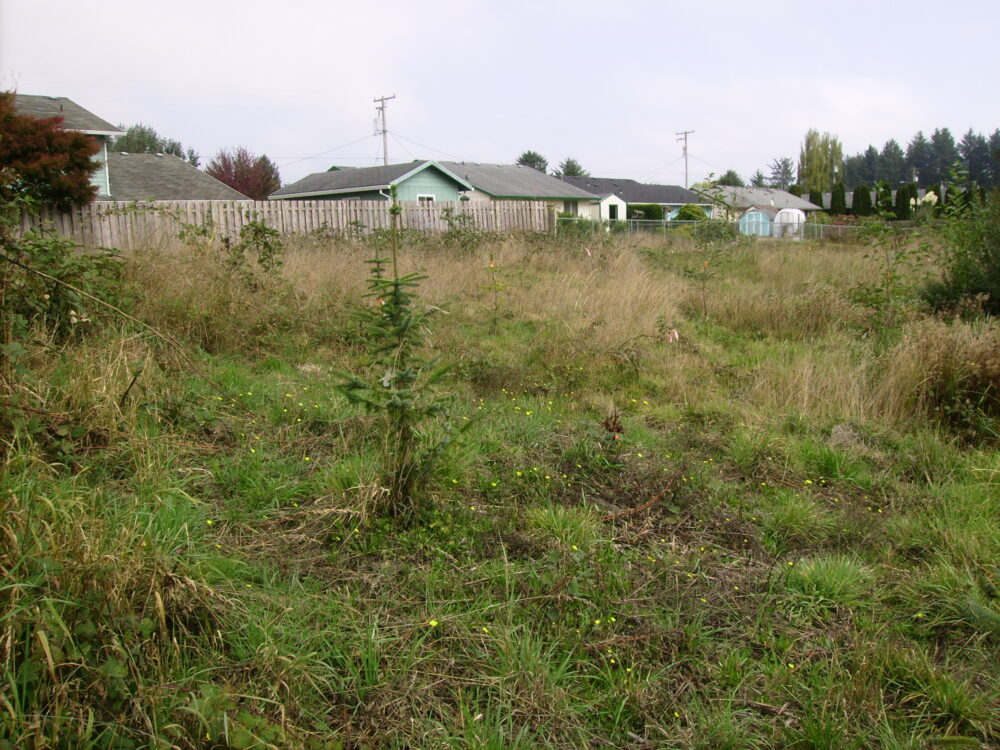

Before (2005) and after (2026) photos of Holden Creek in Tillamook, OR. There were 331 native trees, and 111 native shrubs planted across 1600 ft of riparian area. The area looks entirely different today, with mature trees dominating the riparian zone.
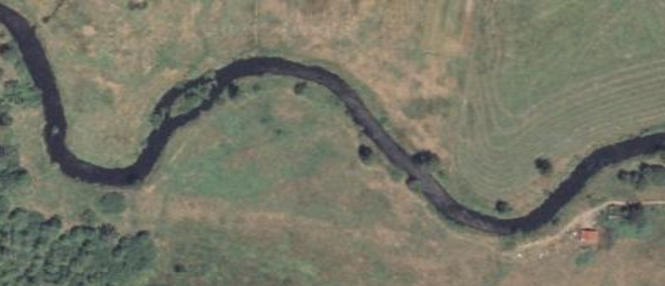
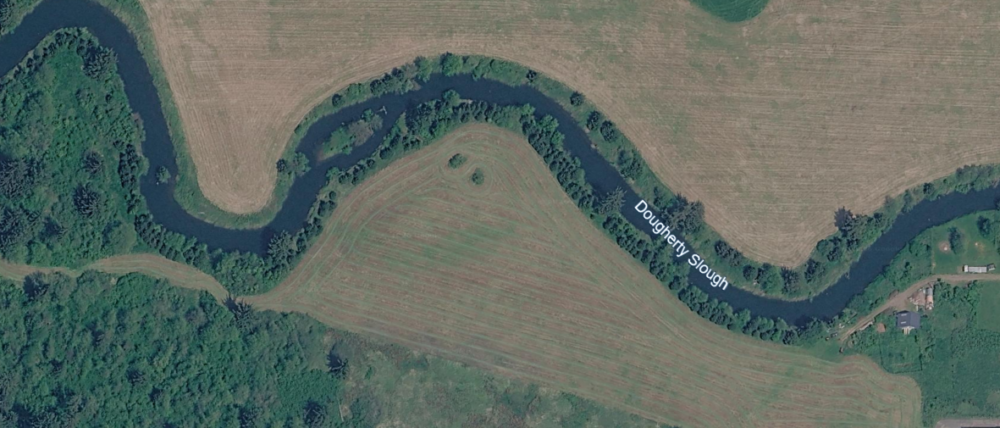
Before (2005) and after (2024) photos taken from Google Earth images of Dougherty Slough in Tillamook, OR. In 2009, 900 trees, 50 shrubs, and 1,000 cuttings were planted across 3,600 ft of riparian area encompassing 3.3 acres.

Community Perspective
The Backyard Planting Program has had many positive impacts on Tillamook County’s community. When the program first started, there was some resistance because it was a new program and many landowners were skeptical of losing grazing land, or having their land transform into something that wouldn’t meet their needs. Over the years since its creation, support for the Backyard Planting Program and other restoration programs like it in Tillamook County has grown significantly, and has fostered increased awareness for local environmental concerns.
Ray Monroe, district manager for Tillamook Soil Water and Conservation District, states that the Backyard Planting Program is a positive thing for Tillamook County, and that it’s success is attributed to doing the work with our people and integrating the environmental community with the rural residential and farming communities.
Related Posts
Photo Contest!


BYPP By the Numbers: Sea Grant Project

22 Years of Backyard Planting Program: Mini Documentary